RGB vs RGBW vs RGB+CCT vs Addressable: Which LED Type Is Right for You?
Walk into any LED store or browse Amazon and you’ll hit a wall of acronyms: RGB, RGBW, RGB+CCT, addressable. They all look like glowing strips, but they behave very differently under the hood. Pick the wrong type and you’ll either miss the pure white you needed or overpay for features you’ll never use.
Here’s the breakdown of what each type does, where it shines, and where it falls short.
Basic RGB (3-Channel)
Basic RGB is the simplest LED strip. Each pixel packs a red, green, and blue LED. By varying the brightness of each channel you can mix millions of colors — purple by mixing R+B, teal from G+B, yellow from R+G, and every shade in between.
What it can’t do well is white. To make white, all three channels fire at 100%, which produces a slightly blue-off-white (around 6500K-7000K depending on the LED die). It looks okay on its own but sits next to a real white light source and the difference is obvious.
Wiring is straightforward — three channels controlled by PWM (pulse-width modulation). On a constant-voltage strip that’s typically VCC + R + G + B (common anode) or VCC + PWM channels on an analog controller.
Best for: accent lighting, color washes, party lights, backlighting TVs, any project where you want colorful effects and don’t need a crisp white. It’s the cheapest option by a noticeable margin.
RGBW (4-Channel with Dedicated White)
RGBW adds a fourth channel: a dedicated white LED alongside the red, green, and blue dies. That single change fixes the biggest weakness of basic RGB.
With the white channel, you get pure, neutral white — no blue tint, no color shift. The white LED is typically a fixed temperature (most often 4000K neutral or 2700K warm) and is significantly brighter than RGB-mixed white because it doesn’t waste light mixing three channels.
The strip operates on four PWM channels. On the controller side, that means either a 4-channel receiver (like many RF + RGBW controllers) or two fewer outputs available on your DMX decoder.
Best for: under-cabinet kitchen lighting, retail displays, bathroom vanities, any spot where you alternate between white illumination and color effects. Expect to pay about 20-30% more than basic RGB — worth it if you care about white quality.
RGB+CCT (Tunable White + Color)
RGB+CCT takes the RGBW concept further by replacing the single white LED with two white LEDs: a warm white (typically 2700K-3000K) and a cool white (6000K-6500K). That gives you five control channels: R, G, B, WW (warm white), and CW (cool white).
By mixing the two white channels you can dial any correlated color temperature from candlelight warmth through sunlight. This makes RGB+CCT the go-to for architectural and circadian-rhythm lighting where white quality and tunability matter more than animated effects.
These strips are almost always 24V constant-voltage to keep current manageable across five channels. Controllers are specialized — standard RGB controllers won’t work — and you’ll need a 5-channel receiver.
Best for: architectural lighting, living room coves, circadian rhythm lighting schemes, hotel lobbies, restaurants, any installation where the lighting designer needs full control over white temperature alongside color accents. It’s the most expensive non-addressable option.
Addressable RGB (WS2812B, SK6812, etc.)
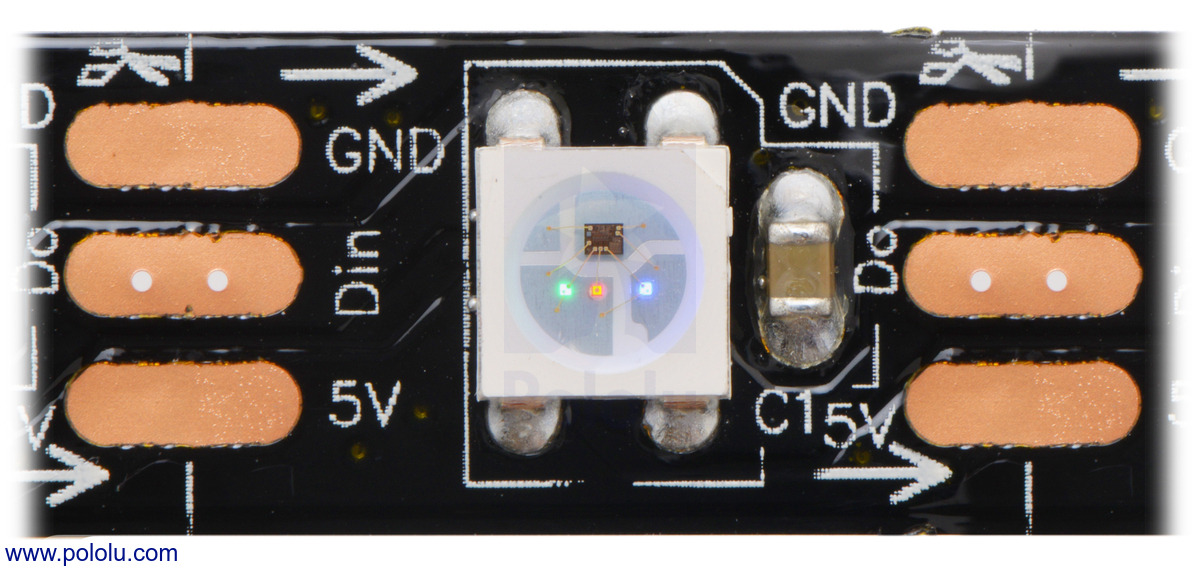
Addressable RGB (also called pixel LED or individually addressable) is where things get interesting. Instead of the whole strip showing one color, every single LED has its own driver chip and can be set to a different color at the same time.
The most popular chips are the WS2812B (3-channel, 5V), the SK6812 (drop-in compatible, slightly more efficient), and the APA102 (4-wire with separate clock for higher refresh rates). Despite having RGB channels, these aren’t controlled by simple PWM — they use a serial data protocol (usually single-wire NRZ for WS2812B/SK6812 or SPI for APA102).
One LED to the next, you can create chasing effects, gradients, scrolling text, music visualization, and full animation. This makes addressable strips the only choice for LED matrices, holiday light shows, and any dynamic installation.
The catch: white quality is identical to basic RGB (blue-tinted) unless you buy the special variant below. Wiring is also more involved — you need a data line (sometimes two for APA102) and power injection becomes critical on long runs.
Best for: matrices, holiday light shows, music-reactive installations, gaming room accent walls, digital signage, wearable LED projects.
Addressable RGBW (SK6812 RGBW)
The SK6812 RGBW is the addressable world’s answer to the white problem. It’s an SK6812 variant that packs four channels — R, G, B, and a dedicated white LED — inside each pixel, all individually controllable over the same single-wire data protocol.
You get the best of both worlds: addressable animations and effects plus a true, clean white channel for illumination. The white LED is typically 4000K neutral, though warm-white variants exist.
The trade-off is cost and complexity. SK6812 RGBW strips cost more than regular WS2812B or SK6812 RGB strips. They also require more current (four LEDs lit per pixel) and compatible controllers that understand the 4-channel data format. WLED supports them, as do most modern pixel controllers.
Best for: permanent architectural installations that want effects for holidays and parties but need clean white light the rest of the year. Also ideal for any addressable project where white quality matters — think retail signage that shows both color animations and white text.
Quick Decision Matrix
Need a quick answer? Here’s the cheat sheet:
| Need | Best Choice |
|---|---|
| Accent color, white not important | Basic RGB (cheapest) |
| Kitchen under-cabinet (color + white) | RGBW |
| Tunable white temperature from warm to cool | RGB+CCT |
| Animations, effects, scrolling text | Addressable RGB |
| Animations and true white light | Addressable RGBW (SK6812) |
One more thing: these categories aren’t always mutually exclusive. Some advanced controllers (like the QuinLED Dig-Quad or ESPixelStick) can drive addressable strips and dim standard analog strips. And WLED can run WS2812B, SK6812 RGBW, and analog PWM strips from the same board with add-on hardware. Start with what kind of light you need — animated or static, white or color — and the hardware decision follows naturally.