LEDEdit Software and T-Series/K-Series Controllers: Complete Guide
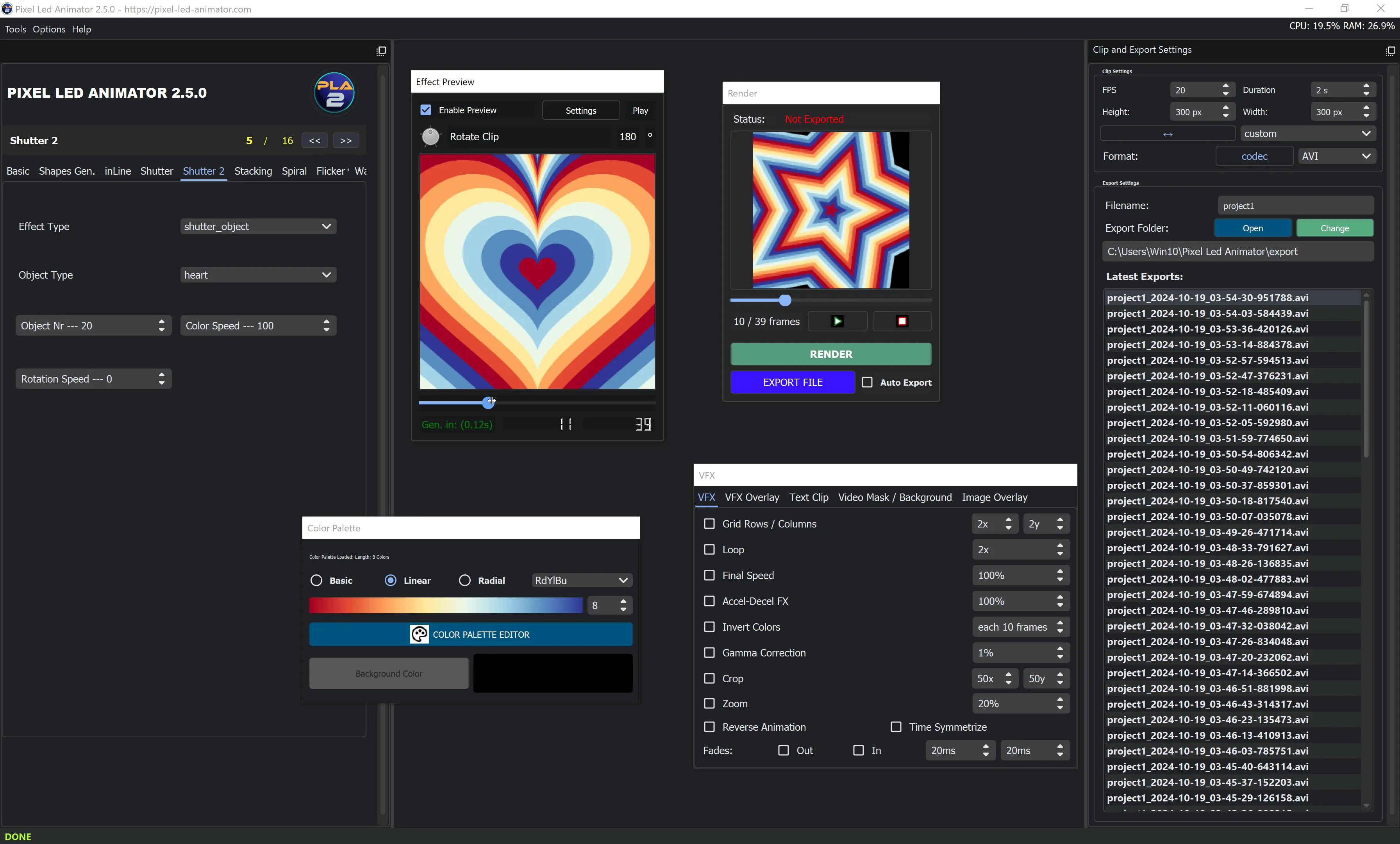
LEDEdit is a free Windows-based software suite for creating pixel LED effects and exporting them to a microSD card for offline playback on dedicated hardware controllers. Developed by Hunan Ruicai Intelligent Technology, it powers millions of architectural lighting installations, channel letter signs, building facades, and LED matrices worldwide.
How LEDEdit Works
The LEDEdit workflow is refreshingly simple — no network connection, no real-time PC required during show time:
- Create a project — choose your controller model and pixel IC
- Define your layout — draw pixel positions manually, import a DXF from AutoCAD/CorelDRAW, or use the automatic matrix generator
- Add effects — pick from 2300+ built-in effects or import video files (AVI, SWF, GIF) as your animation source
- Export to SD card — the software generates a
.ledfile with all timing, layout, and animation data - Play standalone — insert the SD card into the controller, power on, and the show runs autonomously
The key advantage: once programmed, the controller needs only power. No WiFi, no Ethernet, no PC. This makes LEDEdit+T-series the most reliable choice for permanent installations where uptime matters.
Supported Pixel ICs
LEDEdit supports virtually every SPI/NRZ pixel chip on the market, including:
- WS2811 / WS2812B / WS2813 / WS2815 — the most common addressable LEDs
- SK6812 / SK6813 — RGBW variant
- APA102 / APA107 — 2-wire SPI (higher refresh rate)
- LPD6803 / LPD8806 / LPD1886 — legacy SPI chips
- TM1803 / TM1804 / TM1809 / TM1812 — older but still widely used
- UCS1903 / UCS1909 / UCS1912 / UCS2903 / UCS3903 — cost-effective Chinese ICs
- SM16703 / SM16709 / SM16712 / SM16715 / SM16716
- GS8205 / GS8206 / GS8512 / GS8516
- DMX512 — standard DMX decoders (UCS512, WS2821, SM512, etc.)
- TLS3001 / TLS3008 — long-distance transmission ICs
- P9813 / BS0901 / BS0815 — various specialty chips
Selecting the correct IC model in LEDEdit is critical — choose the matching software module (e.g., T-1000-WS2811 for a T1000S with WS2811 pixels).
T1000S — The Entry-Level Workhorse
The T1000S is the most popular single-port SD card controller. It is compact, costs around $16–$35, and handles up to 2,048 pixels.
| Spec | Detail |
|---|---|
| Outputs | 1 port (TTL SPI + RS485 + DMX) |
| Max pixels | 2,048 |
| Voltage | DC 5–24V |
| Max programs | 16 |
| Storage | microSD (128MB–2GB, FAT32) |
| Frame rate | 30 fps at ≤512 px, ~15 fps at 2,048 px |
| Cascade | Yes — chain multiple controllers via A/B IN/OUT |
| Price | $16–$35 |
Best for: small signs, single-zone matrices, holiday displays, accent lighting on a budget.
K1000C — Single Port with DMX Features
The K1000C is an enhanced version of the T1000S with built-in DMX address writing, more program slots, and optical isolation for long-distance cascading.
| Spec | Detail |
|---|---|
| Outputs | 1 port (TTL + DMX + coding line) |
| Max pixels | 2,048 (SPI) / 512 (DMX) |
| Max programs | 32 |
| Voltage | DC 5–24V |
| DMX features | Built-in address writer for UCS512, WS2821, SM512 etc. |
| Cascade | Optical isolation, up to 150m between units |
| Price | $37–$55 |
Best for: installations needing DMX pixel support, larger single-zone projects, and cascaded multi-controller setups where long cable runs are needed.
T8000 Series — 8-Port Powerhouse
The T8000 family handles up to 8,192 pixels across eight independent output ports. Four variants exist:
- T8000 (base) — 8-port TTL, DC 7.5–24V
- T8000AC — AC mains powered (110–230V), 7-segment display
- T8000C — RJ45 networking ports for console sync
- T8000A-TTL — LCD display, external DC power
| Spec | Detail |
|---|---|
| Outputs | 8 ports (TTL SPI + RS485) |
| Max pixels | 8,192 total (1,024 per port) |
| Voltage | DC 7.5–24V + DC 5V (separate) or AC 110–230V |
| Max programs | 16 |
| DMX mode | Up to 4,096 pixels (512 × 8) |
| Frame rate | 30 fps per port at ≤512 px |
| Price | $85–$140 |
Best for: building facades, large signage, multi-zone architectural lighting, any project needing 2,000+ pixels.
K8000C — 8-Port with Art-Net / sACN
The K8000C adds Ethernet connectivity to the 8-port formula, supporting Art-Net and sACN protocols for real-time control alongside SD-card offline playback.
| Spec | Detail |
|---|---|
| Outputs | 8 ports (TTL + RS485/DMX per port) |
| Max pixels | 8,192 total (1,024 per port) |
| Network | Ethernet — Art-Net, sACN |
| Max DMX | 4,096 (512 × 8) |
| Cascade | Optical isolation, up to 150m |
| Price | $85–$95 |
Best for: projects that need both offline SD-card playback and real-time Art-Net/sACN control from lighting consoles or media servers.
Other Models
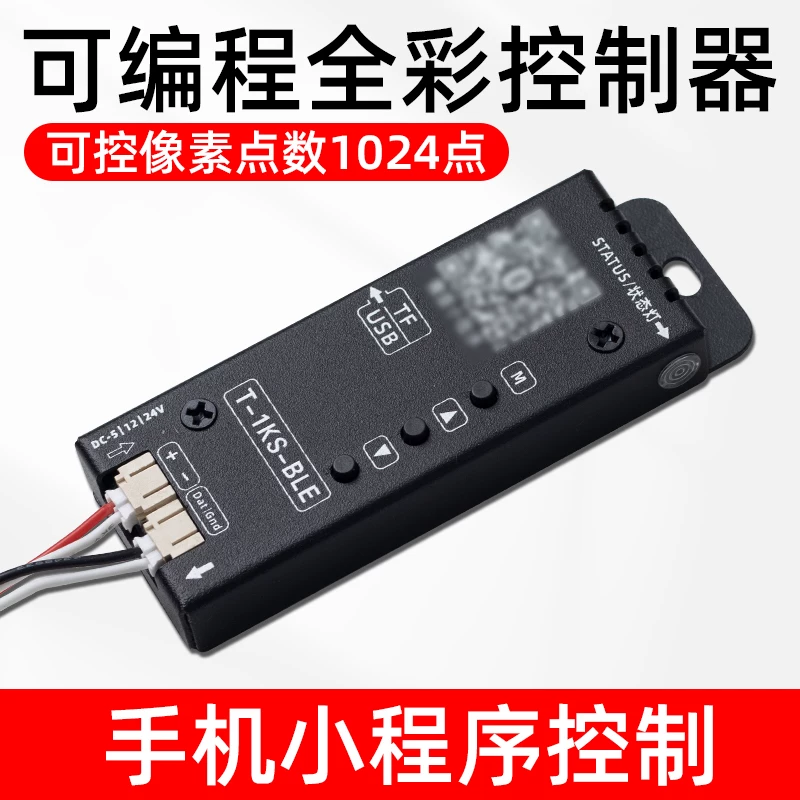
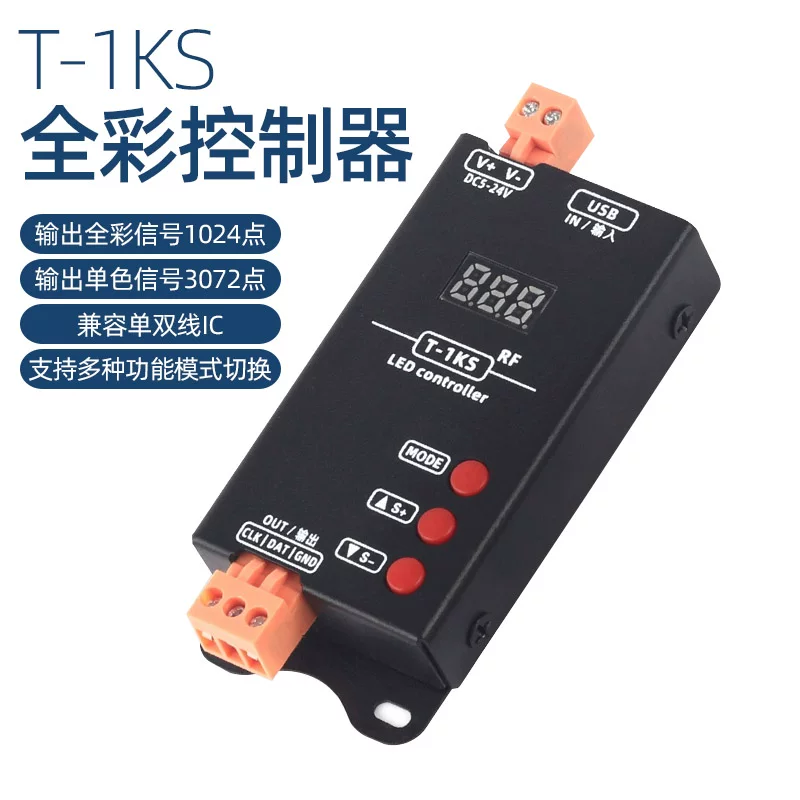
- T1KS / T2KS / T4KS / T8KS — newer generation “KS” series with Bluetooth (T1KS-BLE) option
- T300K / T600K — online + offline 8-port controllers, ~$80–$120
- K4000C / K8000D — higher-capacity models with cloud and Ethernet support
- LEDEdit PRO software — $199 one-time license adds DXF import, layered timeline, and batch export
Wiring Guide
All T-series and K-series controllers use a standard 3-pin or 4-pin output:
| Pin | Signal (3-wire) | Signal (4-wire) |
|---|---|---|
| 1 | DAT (data) | DAT (data) |
| 2 | GND (ground) | CLK (clock) |
| 3 | VCC (+5V/+12V) | GND (ground) |
| 4 | — | VCC (+5V/+12V) |
For DMX mode, use the A/B terminals (RS-485 differential pair). Always ensure the power supply ground is shared between the controller and the first pixel.
LEDEdit vs Alternatives
| Feature | LEDEdit | xLights + FPP | MADRIX | WLED |
|---|---|---|---|---|
| Price | Free | Free | Paid licenses | Free |
| Offline playback | ✅ SD card | ✅ FPP | ❌ | ❌ |
| Max pixels (single unit) | 8,192 (T8000) | Unlimited | Unlimited | ~2,500 |
| Chip support | 100+ ICs | Limited | Limited | 30+ ICs |
| Real-time control | ❌ | ✅ | ✅ | ✅ |
| Art-Net / sACN | K8000C only | ✅ | ✅ | Via add-on |
| Platform | Windows only | Win/Mac/Linux | Win/Mac | Web UI |
| Learning curve | Low | Medium | High | Low |
Summary
LEDEdit + T-series/K-series controllers occupy a specific niche: reliable, low-cost, offline pixel LED control. If you need a permanent installation that plays the same show every day without a network dependency — and you want to spend $16–$140 on the controller rather than $500+ on a MADRIX setup — LEDEdit is the right choice.
For real-time VJ work, live busking, or projects needing thousands of video-mapped pixels, pair a K8000C (for Art-Net) with MADRIX or Resolume. For simple WiFi-controlled effects at home, WLED is hard to beat. But for signage, architectural lighting, and channel letter installations, the LEDEdit ecosystem is the industry standard.