Choosing LED Strip Density: 30 vs 60 vs 144 LEDs/m
The first decision when buying LED strip is density: how many LEDs per meter. It shapes everything — resolution, brightness, power draw, and cost. Pick wrong and you’ll either waste money on power you don’t need or end up with chunky pixels that ruin your effect. Here’s how to decide.
What Does “LEDs per Meter” Mean?
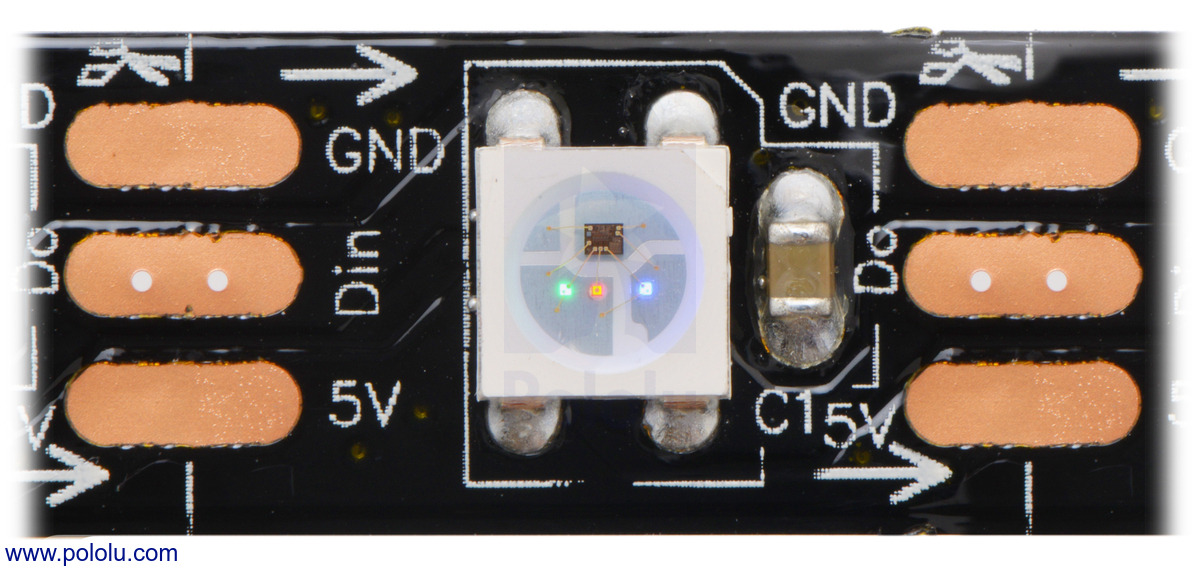
LED strip density is exactly what it sounds like: the number of individually addressable LEDs packed into one meter of strip. The three most common densities are 30, 60, and 144 LEDs/m (sometimes sold as 30/m, 60/m, and 144/m).
These numbers directly determine pixel spacing. Here’s how they break down:
| Density | Pixel Spacing | LEDs per 5m Reel |
|---|---|---|
| 30/m | 33.3 mm | 150 |
| 60/m | 16.7 mm | 300 |
| 144/m | 6.9 mm | 720 |
At 30 LEDs/m, each pixel is over an inch apart. At 60/m they’re roughly finger-width apart. At 144/m the pixels blur into a nearly continuous line — you can’t distinguish individual LEDs at normal viewing distance.
Visually, a 30/m strip looks like a string of discrete bulbs. A 144/m strip looks like a solid ribbon of light. 60/m sits in between: individual pixels are visible up close but blend at arm’s length.
30 LEDs/m — Best for Long Runs
30 LEDs/m is the economical choice. It draws 18W per meter at full white (5V), which means you can run longer lengths before voltage drop forces you to inject power.
Pros:
- Lowest power draw — great for battery-powered projects
- Cheapest per meter — roughly half the cost of 60/m
- Runs 4-5 meters before needing power injection
- Easier soldering thanks to wider pads
Cons:
- Chunkier pixels — visible as distinct dots
- Animations look jerky at close range
- Not suitable for text or detailed patterns
Best for: Holiday rooflines, perimeter/accent lighting, cove lighting, pathway markers, long architectural runs, temporary installations. If your strip will be viewed from more than 2 meters away, 30/m is often enough.
60 LEDs/m — The All-Rounder
60 LEDs/m is the default choice for most projects. It balances resolution, power, and cost better than any other density. It draws 36W per meter at full white.
Pros:
- Good resolution for animations and effects
- Pixels blend at normal viewing distance (~1m+)
- Readily available in every chipset (WS2812B, APA102, SK6812)
- Reasonable power requirements
Cons:
- Needs power injection every 3-4 meters at full white
- Still visibly pixelated for text at close range
- Price adds up for large installations
Best for: LED matrices, general-purpose installations, indoor accent walls, behind TVs, under-cabinet lighting, most hobbyist projects. When in doubt, pick 60/m — it’s the sweet spot.
144 LEDs/m — High-Resolution
144 LEDs/m is for when you want smooth, seamless light. The pixels are packed so tightly they form a continuous ribbon. It draws 72W per meter — double the 60/m density at the same brightness.
Pros:
- Silky smooth animations with no visible pixelation
- Excellent for matrices and video displays
- Text and fine details are legible
- High brightness density per meter
Cons:
- 72W per meter — needs power injection every 1-2 meters
- Expensive — often 2-3× the cost of 60/m
- Heat buildup in enclosed spaces
- Requires beefy power supplies and thick wiring
Best for: LED matrices and video panels, indoor art installations, short feature runs (1-3m), museum exhibits, retail displays. Unless you need the resolution, stick with 60/m — 144/m is overkill for most accent lighting.
Power Implications
Density directly dictates power. Every LED draws the same current regardless of how close its neighbor is. More LEDs per meter = proportionally more power.
| Density | Power/m (Full White, 5V) | Injection Interval |
|---|---|---|
| 30/m | 18W (3.6A) | Every 4-5m |
| 60/m | 36W (7.2A) | Every 3-4m |
| 144/m | 72W (14.4A) | Every 1-2m |
For a 5-meter run at full white:
- 30/m: 90W total — one power supply connection at the start may be enough
- 60/m: 180W total — needs injection at both ends or midpoint
- 144/m: 360W total — requires multiple injection points and a 360W+ PSU
Voltage drop hits denser strips harder because they draw more current through the same copper traces. A 144/m strip will show visible dimming within 1 meter unless you inject power early and often.
The bottom line: choose the lowest density that meets your resolution requirements. You’ll save money, simplify wiring, and avoid thermal headaches. For most people, that’s 60/m.